Three cars, three fates
One burned, one vanished, one survived in a back garden. Even the sources can’t agree on all of it.
Two more cars, and no more money
Alfred Taylor, a London engineer who wanted a licence to sell the car overseas, had agreed to pay $5,000 for a demonstration car. Slate (Alec Nevala-Lee), 2022
Car No. 2 was finished in January 1934. Its British buyers had cancelled, and Hemmings says it was later sold to a group of the company’s mechanics. Hemmings (Kurt Ernst)
Hagerty says Fuller kept the second car as a demonstrator after his next customer cancelled, and rolled it in May 1935 with his wife and daughter inside. Hagerty (Lane museum)
Car No. 3 had a prominent tail fin, reportedly to improve airflow and handling. It was eventually sold to the conductor Leopold Stokowski, who later used it to promote war bonds in Brooklyn. Hemmings (Kurt Ernst) By then investors’ money had dried up, and Fuller reportedly spent most of his family inheritance building car No. 3. Hemmings (Kurt Ernst)
Fuller booked a stand at the 1934 New York Auto Show, but Hemmings says pressure from Chrysler got it cancelled. He parked outside the main entrance instead, drawing perhaps bigger crowds than the new Chrysler Airflow inside. Hemmings (Kurt Ernst)
He took the Dymaxion back to the Chicago World’s Fair in 1934, but no sales or investors followed. Hemmings (Kurt Ernst) In 1934 Isamu Noguchi drove an original Dymaxion on a road trip to Connecticut. Lane Motor Museum, 2015
Only two more cars were built before the company folded. Slate (Alec Nevala-Lee), 2022
Fuller later claimed, falsely, that he had paid back his investors, and his official biographies left Biddle out. Slate (Alec Nevala-Lee), 2022 Decades later he still insisted: “She was the most stable car in history.” Slate (Alec Nevala-Lee), 2022
Car No. 1: burned
Gulf repaired car No. 1 and later sold it to an engineer who had tested it at the National Bureau of Standards. It was then used to advertise soft drinks, and was destroyed in 1943 when it caught fire after refuelling. Slate (Alec Nevala-Lee), 2022 Hemmings puts that fire in a garage in Washington, DC. Hemmings (Kurt Ernst)
How did car No. 1 end? Sources differ
- Hagerty’s road-trip report says car No. 1 was destroyed in a rollover in 1939. Hagerty (road trip)
- The Lane Motor Museum’s summary says two of the cars were sold, and one was destroyed in a crash, the other in a fire. Lane Motor Museum, 2015
- The National Automobile Museum’s 2007 page said three were built in 1933 and 1934 before Fuller ran out of cash, and that Nos 1 and 3 had disappeared. National Automobile Museum (2007)
Car No. 3: vanished
Car No. 3 disappeared after the Second World War, possibly in a Korean War scrap drive. Hemmings (Daniel Strohl)
CNN says it was cut up for scrap metal in the 1950s. CNN, 2019
Car No. 2: the survivor
The earliest known owners of car No. 2 were a Bridgeport couple, who sold it for $1 in 1950 to Theodore Mezes of Mesa, Arizona. He left it in his back garden to deteriorate until 1968. Hemmings (Daniel Strohl)
That year three University of Arizona engineering students recognised it and, afraid of being outbid by Bill Harrah, paid $3,000 for it. Hemmings (Daniel Strohl)
CNN’s version has Arizona State engineering students finding it on a farm, where it had been used as a chicken coop. CNN, 2019
The students lent it to museums, then sold it to Harrah in 1978 for $20,000. It passed with part of his collection to the National Automobile Museum. Hemmings (Daniel Strohl)
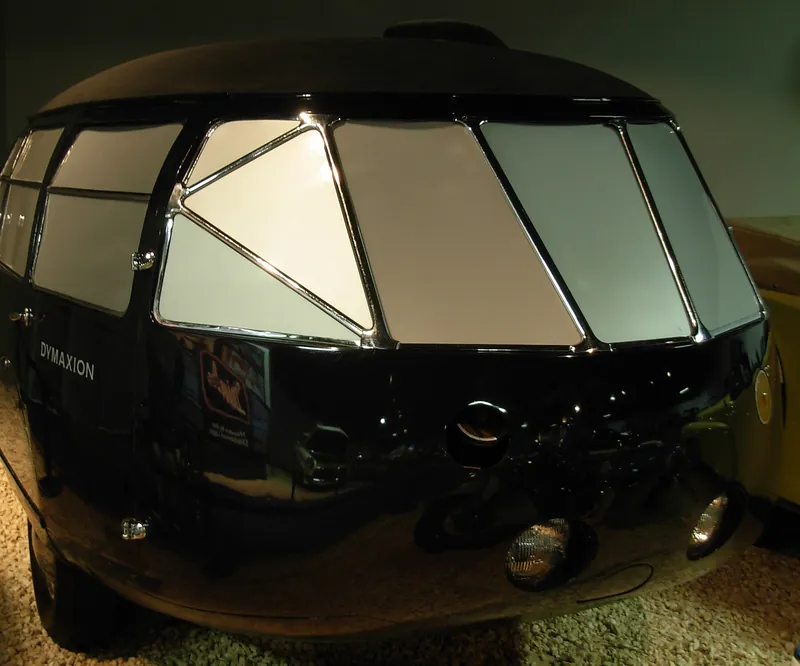
For years it did not run, and its interior was so poor that the museum blocked off its windows. Hemmings (Daniel Strohl)
Prompted by the architect Norman Foster, the British firm Crosthwaite and Gardiner gave No. 2 a cosmetic restoration, including a new interior. Hemmings (Daniel Strohl) Hemmings’ Kurt Ernst dates that restoration to 2009. Hemmings (Kurt Ernst)
The museum then went looking for a working 1934 Ford flathead V-8 to make it run, and in September 2018 launched a fundraising campaign for the mechanical work. Hemmings (Daniel Strohl)
When CNN visited in 2019, the cosmetic work was finished and the museum was researching the mechanics, hoping to make it run again. CNN, 2019
The replicas
Foster also had Crosthwaite and Gardiner build a new Dymaxion from scratch. Painted green with a white roof and a stabilising fin, it was first shown in 2010. Hemmings (Daniel Strohl)
Which car it copies depends on whom you read. Daniel Strohl of Hemmings says it was patterned on No. 2. Hemmings (Daniel Strohl) A Hemmings photo caption by Kurt Ernst calls it a recreation of No. 3. Hemmings (Kurt Ernst)
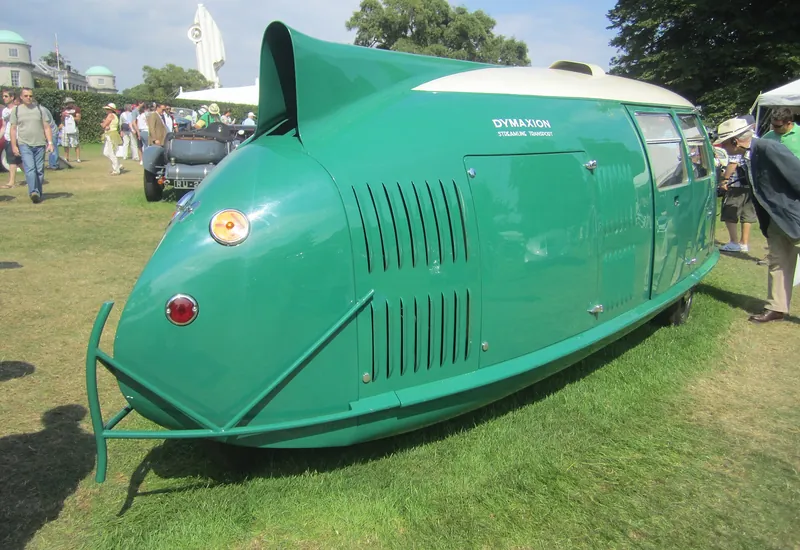
The Lane Motor Museum in Nashville finished its replica of car No. 1 in 2015, after eight years, and put it on display from 26 February. Lane Motor Museum, 2015
It sits on a 1935 Ford chassis with a 1940 engine. Its wooden body frame was made in the Czech Republic by Mirko Hrazdira. Hagerty (road trip)
Jeff Lane once drove it the 600 miles to the Amelia Island Concours in Florida. Hagerty (Lane museum)
The same museum looks after the 1967 Gyro-X, a two-wheeled car held up by a gyroscope. Hagerty (Lane museum) Its story is on the Gyro-X site.
Did anything come of it?
Front-wheel drive, though with the engine at the front, is now the industry standard. Hemmings (Kurt Ernst)
Hemmings sees its use of interior space, like the Stout Scarab’s, as a forerunner of the minivan. Hemmings (Kurt Ernst)
Hemmings adds that after the crash and the bad publicity, few builders, professional or amateur, have tried a car laid out like it. Hemmings (Kurt Ernst)
Timeline
- 1943 Gulf repaired car No. 1 and later sold it to an engineer who had tested it at the National Bureau of Standards. It was then used to advertise soft drinks, and was destroyed in 1943 when it caught fire after refuelling. Slate (Alec Nevala-Lee), 2022
- 1950 The earliest known owners of car No. 2 were a Bridgeport couple, who sold it for $1 in 1950 to Theodore Mezes of Mesa, Arizona. He left it in his back garden to deteriorate until 1968. Hemmings (Daniel Strohl)
- 1968 That year three University of Arizona engineering students recognised it and, afraid of being outbid by Bill Harrah, paid $3,000 for it. Hemmings (Daniel Strohl)
- 1978 The students lent it to museums, then sold it to Harrah in 1978 for $20,000. It passed with part of his collection to the National Automobile Museum. Hemmings (Daniel Strohl)
- 2010 Foster also had Crosthwaite and Gardiner build a new Dymaxion from scratch. Painted green with a white roof and a stabilising fin, it was first shown in 2010. Hemmings (Daniel Strohl)
- 2015 The Lane Motor Museum in Nashville finished its replica of car No. 1 in 2015, after eight years, and put it on display from 26 February. Lane Motor Museum, 2015
Next: myths vs facts →