From a flying-car sketch to a factory in Bridgeport
Fuller wanted a vehicle that might one day fly. What he built, in a hurry and on borrowed money, was a car.
The car, not the house or the map. Fuller used the name Dymaxion for many of his inventions. This site is about the three-wheeled car of 1933 and 1934; see the home page for how it differs from the Dymaxion House.
An idea with wings
Fuller was sketching the idea, as a flying vehicle, as early as 1927. Hemmings (Kurt Ernst) Fuller saw it as more than a car. He disliked the press calling it the “Dymaxion car”, and imagined a later version with wings. Hemmings (Kurt Ernst)
His first sketches of what he called the 4D Transport borrowed the egg-shaped outline from Le Corbusier’s book Towards a New Architecture, adding three wheels on a triangulated frame. Slate (Alec Nevala-Lee), 2022
He then had his close friend, the sculptor Isamu Noguchi, make models of the 4D Transport, published in Fuller’s magazine Shelter in 1932. Slate (Alec Nevala-Lee), 2022
A flying version was beyond his means, so he concentrated on what he called the vehicle’s “ground taxiing” phase. Slate (Alec Nevala-Lee), 2022
Money and a yacht designer
Early in 1933 Anna “Nannie” Biddle, a Philadelphia socialite, offered to fund a working prototype, and advanced $1,000 in February. Slate (Alec Nevala-Lee), 2022
Who paid is disputed: some say Biddle, others the former stockbroker Phillip Pearson. Hemmings thinks both probably contributed. Hemmings (Kurt Ernst)
Fuller hired Starling Burgess, a famed yacht and aircraft designer, as the first employee of what became the 4D Dymaxion Corporation. Slate (Alec Nevala-Lee), 2022
Burgess had designed the America’s Cup J-class yachts Enterprise and Rainbow. Hemmings (Kurt Ernst)
For parts, they spent $450 on a Ford Tudor and took its engine, running gear, chassis frame and gearbox. Slate (Alec Nevala-Lee), 2022
Bridgeport, 1933
Work began in Bridgeport, Connecticut, in March 1933, on the morning of Franklin D. Roosevelt’s inauguration. Slate (Alec Nevala-Lee), 2022 A thousand workers reportedly applied for a handful of jobs. Slate (Alec Nevala-Lee), 2022
After two earlier workshops, the team moved in June 1933 into a Bridgeport factory that had belonged to the Locomobile Company of America. Slate (Alec Nevala-Lee), 2022
Hemmings places the work in the old Locomobile factory’s dynamometer room, on the west side of Bridgeport Harbor. No trace of it seems to survive. Hemmings (Daniel Strohl, Bridgeport)
The staff grew to seventeen: in the writer Robert Marks’s words, Polish sheet-metal experts, Italian machine-tool men, Scandinavian woodcraftsmen and former Rolls-Royce coachmakers. Slate (Alec Nevala-Lee), 2022
An April 1933 test showed that the single rear wheel gave a “death wobble” at high speed. A hinge in the right place cured it. Slate (Alec Nevala-Lee), 2022
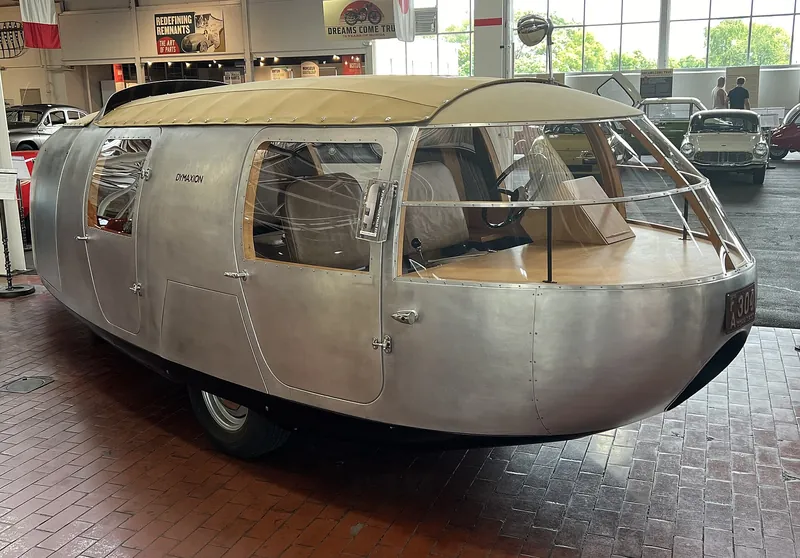
Car No. 1
Car No. 1 was finished on 12 July 1933, Fuller’s 38th birthday. Slate (Alec Nevala-Lee), 2022 It was unveiled on 21 July at the Locomobile plant before 3,000 people, among them the painter Diego Rivera. Slate (Alec Nevala-Lee), 2022
Hemmings gives 12 July 1933 as the date of its public debut. Hemmings (Kurt Ernst)
It was 19 feet long, weighed about 2,700 lb and cost $8,000, at a time when a 1932 Ford V-8 sold for less than $700. Slate (Alec Nevala-Lee), 2022
Hemmings describes the first car as under 2,300 lb and 20 feet long, with room for 11. Hemmings (Kurt Ernst)
Showing off
In New York Fuller showed off by turning tight circles round traffic policemen. With officers asking for a repeat at every junction, one mile took an hour. Slate (Alec Nevala-Lee), 2022
At Roosevelt Field airport the company’s sales manager, the former stunt pilot Frank Coffyn, tested it at 90 mph. Slate (Alec Nevala-Lee), 2022
Fuller was already making outrageous claims, telling one contact that a hundred cars were being built and most had been sold at $2,500. Slate (Alec Nevala-Lee), 2022
Al Williams, head of aviation products at the Gulf Refining Company, bought car No. 1 to promote Gulf at air shows. His $2,500 was far below its cost, but Fuller needed the money. Slate (Alec Nevala-Lee), 2022
Fuller applied for a US patent on 18 October 1933. It was granted on 7 December 1937 as No. 2,101,057, assigned to the Dymaxion Corporation. US patent 2,101,057 Nevala-Lee notes that the patent treated the three wheels as optional. Slate (Alec Nevala-Lee), 2022
Then came Chicago. The crash on 27 October 1933 has its own page, because there are two very different versions of it.
Not the only teardrop
Whatever Fuller later implied, it was not the first streamlined car: Chrysler had been testing in wind tunnels for years. Slate (Alec Nevala-Lee), 2022
Hemmings sees its use of interior space, like the Stout Scarab’s, as a forerunner of the minivan. Hemmings (Kurt Ernst)
Stout turns up in another forgotten-machine story too. In 1945 William Stout, designer of the Stout Scarab, predicted atomic-powered cars. Times Colonist (Bill Vance) That prediction opens the story of the Ford Nucleon on nucleon.motoring.im.
Timeline
- 1927 Fuller was sketching the idea, as a flying vehicle, as early as 1927. Hemmings (Kurt Ernst)
- 1932 He then had his close friend, the sculptor Isamu Noguchi, make models of the 4D Transport, published in Fuller’s magazine Shelter in 1932. Slate (Alec Nevala-Lee), 2022
- Feb 1933 Early in 1933 Anna “Nannie” Biddle, a Philadelphia socialite, offered to fund a working prototype, and advanced $1,000 in February. Slate (Alec Nevala-Lee), 2022
- Mar 1933 Work began in Bridgeport, Connecticut, in March 1933, on the morning of Franklin D. Roosevelt’s inauguration. Slate (Alec Nevala-Lee), 2022
- 12 Jul 1933 Car No. 1 was finished on 12 July 1933, Fuller’s 38th birthday. Slate (Alec Nevala-Lee), 2022
- 21 Jul 1933 It was unveiled on 21 July at the Locomobile plant before 3,000 people, among them the painter Diego Rivera. Slate (Alec Nevala-Lee), 2022
- 18 Oct 1933 Fuller applied for a US patent on 18 October 1933. It was granted on 7 December 1937 as No. 2,101,057, assigned to the Dymaxion Corporation. US patent 2,101,057
- 27 Oct 1933 On the morning of 27 October 1933, with Sempill and the French aeronaut Charles Dollfus aboard, the car rolled over on Lake Shore Drive, close to the entrance of the Century of Progress World’s Fair. Slate (Alec Nevala-Lee), 2022
- Jan 1934 Car No. 2 was finished in January 1934. Its British buyers had cancelled, and Hemmings says it was later sold to a group of the company’s mechanics. Hemmings (Kurt Ernst)
- 1934 Fuller booked a stand at the 1934 New York Auto Show, but Hemmings says pressure from Chrysler got it cancelled. He parked outside the main entrance instead, drawing perhaps bigger crowds than the new Chrysler Airflow inside. Hemmings (Kurt Ernst)
Next: how it worked →