Engine at the back, steering at the back
The Dymaxion turned the usual car inside out. Here is the layout, and why it was hard to drive.
The layout
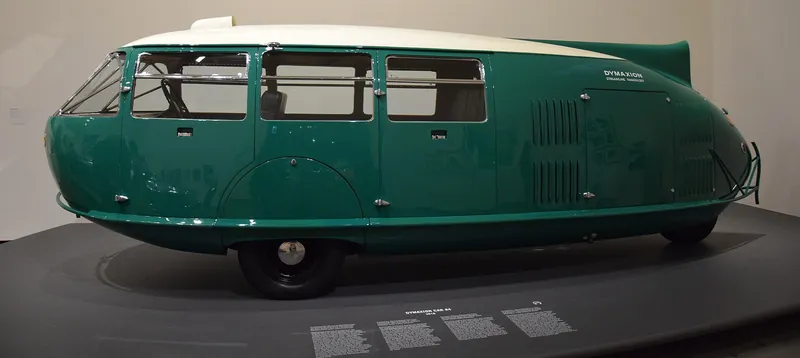
A Ford flathead V-8 sat at the back but drove the front wheels. Hemmings (Kurt Ernst)
The Ford gearbox was turned round to put the engine at the rear. Slate (Alec Nevala-Lee), 2022
Fuller’s patent puts the driven front wheels at the widest part of the body, about a third of the way back from the nose, with the body enclosing all the wheels. US patent 2,101,057
The engine itself was an ordinary Ford V-8 of the day: see how a four-stroke engine works on engines.motoring.im, and how gearboxes and differentials carry its power to the wheels.
Steering from the tail
The single rear wheel did the steering, worked by steel cables, and the car could turn in a circle only slightly bigger than its wheelbase. Slate (Alec Nevala-Lee), 2022
At low speed the rear wheel could swing through up to 90 degrees, so you could park by putting the nose to the kerb and swinging the tail in. Hemmings (Kurt Ernst)
The National Automobile Museum compared the rear wheel to a ship’s rudder. National Automobile Museum (2007)
The patent prefers steering by “a rear wheel or wheels”, and allows the front wheels to steer instead. US patent 2,101,057
Two frames and a hinge
Besides an ash frame carrying the aluminium panels, it had two steel frames, hinged together near the front wheels: one carried the engine, gearbox and driveshaft, the other the weight of the body. Hemmings (Kurt Ernst)
The basic frame had no suspension. The body frame had springs without dampers, and the rear wheel had a spring and damper. Hemmings (Kurt Ernst)
That made rough roads comfortable, but with the seats and weight well forward, the rear wheel sometimes struggled to stay on the ground. Hemmings (Kurt Ernst)
Body and fittings
Under a canvas roof, the body was lacquered aluminium over a wooden frame. Slate (Alec Nevala-Lee), 2022
It had a single headlamp, a crush zone of balsa wood at the front, dry ice for cooling, a wraparound windscreen with no wipers, and a periscope instead of a rear window. Slate (Alec Nevala-Lee), 2022
Why it was hard to drive
Its low steering gearing made it hard to steer, cornering was difficult and it wore its tyres badly. At high speed its tail could come off the road. Slate (Alec Nevala-Lee), 2022
Above about 75 mph the V-shaped underside reportedly tended to make lift, especially at the back. Hemmings (Kurt Ernst)
Fuller admitted it was even worse in crosswinds: “I had to practically fly her along the highway on a northwest gusty day.” Slate (Alec Nevala-Lee), 2022
Driving the Lane museum’s replica, Jeff Lane found 45 mph as fast as he could comfortably go. It wandered on crowned roads, and the steering did not centre itself. Hagerty (road trip)
How fast, and how far on a gallon? Sources differ
- Fuller claimed a top speed of 120 mph and up to 30 mpg. Hemmings (Daniel Strohl)
- Hemmings calls the 120 mph unproven, and unlikely given the lift at speed. Hemmings (Kurt Ernst)
- Nevala-Lee says it evidently peaked at around 90 mph, the fastest it ever went in public. Slate (Alec Nevala-Lee), 2022
- He also says Fuller claimed 40 miles to the gallon. Slate (Alec Nevala-Lee), 2022
- Hemmings gives a claimed 22 mpg fully loaded and up to 30 mpg partly loaded. Hemmings (Kurt Ernst)
- The Lane Motor Museum gives 30 mpg, up to 11 passengers and 90 mph. Lane Motor Museum, 2015
- The National Automobile Museum’s 2007 page said about 120 mph and 25 to 30 mpg. National Automobile Museum (2007)
Next: the 1933 crash →